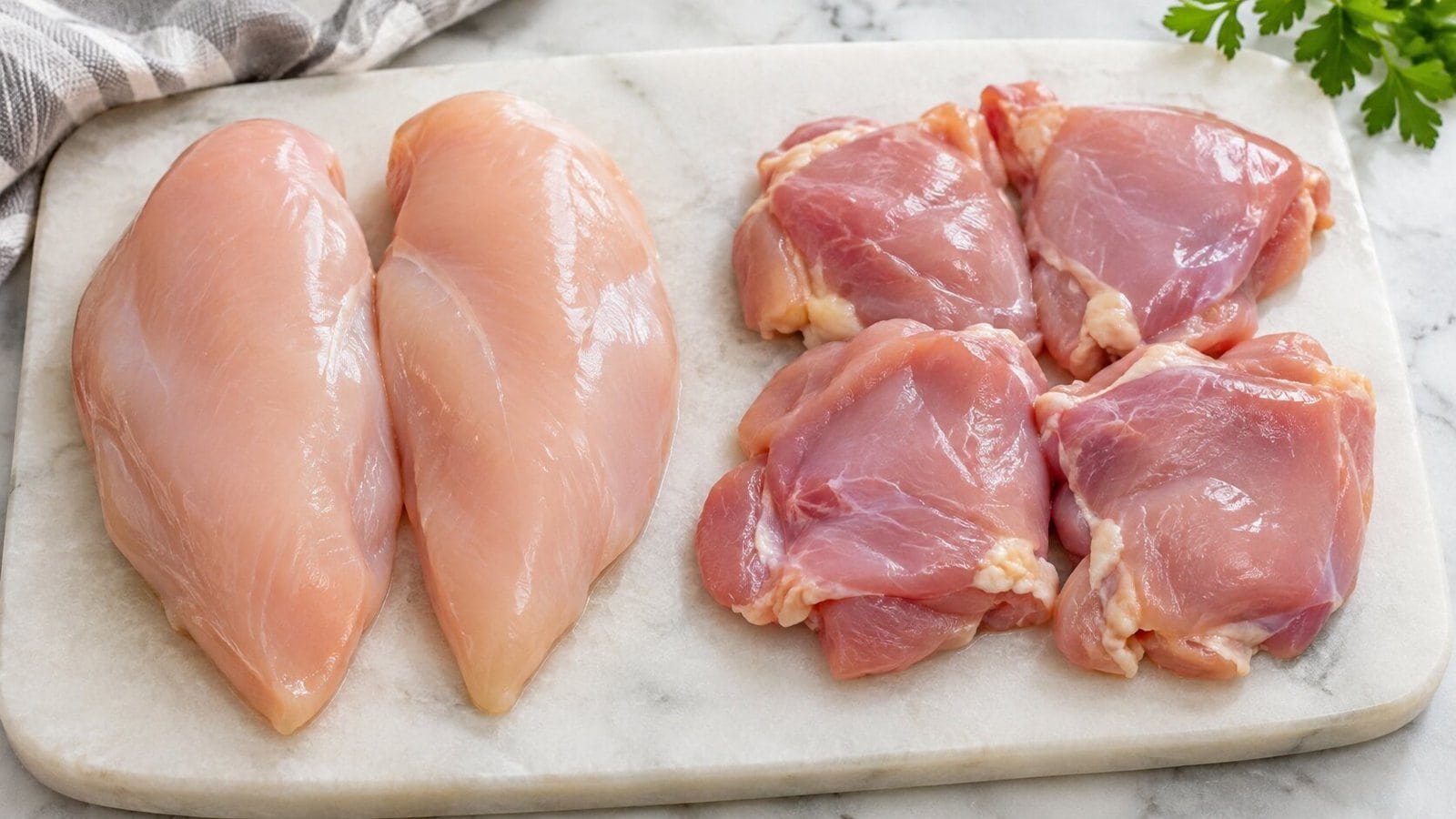
A recipe asks for 500g boneless chicken. At the shop, you have two easy options: breast or thigh.
Both can work. But they will not behave quite the same once they hit the pan.
Breast is leaner and works especially well when the cooking is quick and controlled. Thigh is richer, stays juicier more easily, and usually gives you more room when a dish needs longer cooking.
So the better choice depends less on which cut is “best” and more on what you are planning to do with it.
Chicken Breast vs Thigh at a Glance
| Chicken Breast | Chicken Thigh | |
|---|---|---|
| Meat type | White meat | Dark meat |
| Fat | Lower | Higher |
| Typical cooked texture | Firmer, cleaner bite | Softer, juicier |
| Cooking tolerance | Needs closer timing | More forgiving |
| Quick pan cooking | Very good | Very good |
| Longer simmering | Can become dry if overcooked | Usually handles it better |
| Curry | Good for quicker curries | Well suited to longer cooking |
| Biryani | Can work with careful timing | Usually more forgiving |
| Grilling | Good, but timing matters | Good and easier to keep juicy |
These are tendencies, not fixed rules.
Worth Knowing
For most of this comparison, we are talking about skinless breast and thigh meat, especially the boneless pieces commonly used for everyday cooking. Bone, skin, piece size, marinade, and cooking method can all change the result.
Why Breast and Thigh Cook Differently
Chicken breast comes from the chest. Thigh comes from the upper part of the leg.
Their composition is different too.
Breast is relatively lean, while thigh typically contains more fat and more connective tissue. That difference helps explain why thigh tends to feel juicier when the two cuts are cooked in comparable ways.
Breast can be tender and juicy when the timing is right, but once it is cooked through, continued heating can make it firmer and progressively drier.
Thigh is generally more forgiving, though it can still become overcooked.
You can notice the difference even before cooking.
Raw breast is pale and fairly uniform. Thigh meat is darker and often has more visible fat running through or around it.
Once cooked, the contrast becomes clearer.
Breast has less room for extra cooking once it is done. Thigh usually gives you a little more flexibility.
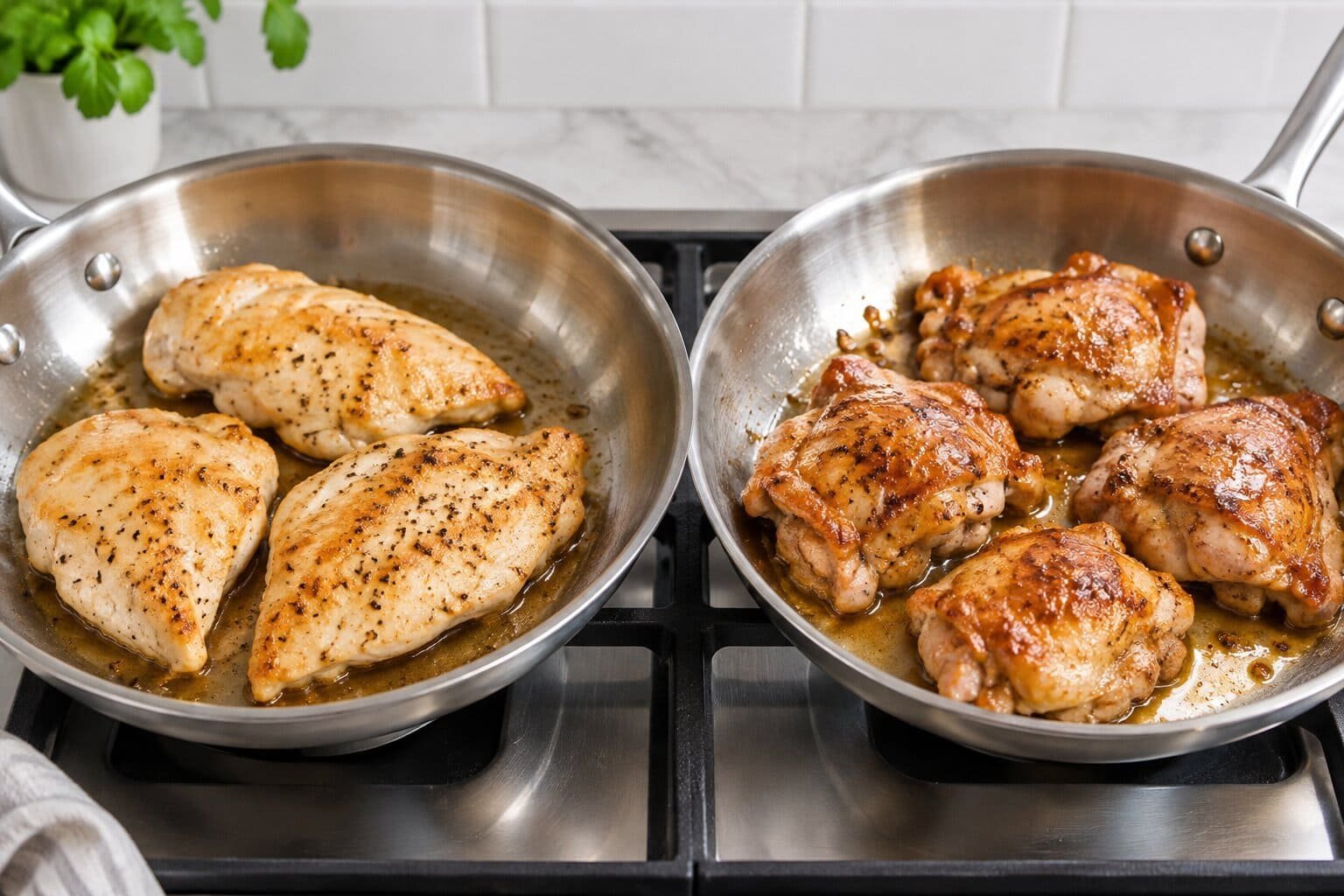
Chicken Breast Works Well When the Cooking Is Quick
Breast makes a lot of sense when you know the chicken will not spend very long over the heat.
Think about small boneless pieces going into a quick pan dish.
They cook through fast, take seasoning well, and give you neat, fairly uniform pieces.
Breast can also work nicely for:
- quick stir-fries;
- thin cutlets;
- grilled chicken;
- skewers and tikka-style pieces;
- sandwiches and wraps;
- curries where the chicken goes in late and cooks only until done.
The important part is knowing when to stop.
If breast pieces are already cooked but the sauce still needs another twenty minutes of simmering, the chicken has to sit through those twenty minutes too. That is where a perfectly good breast can become much firmer than you wanted.
So breast often works best when the rest of the dish is ready for the chicken rather than relying on the chicken to survive a long cooking process.
Chicken Thigh Gives You More Room With Longer Cooking
Thigh becomes especially useful when the chicken needs to stay in the pan for a while.
A curry may need time for the chicken and gravy to cook together. Biryani may put the meat through more than one stage of cooking. Grilled pieces may stay over the heat a little longer than planned.
Thigh usually handles those situations more comfortably.
Its extra fat also gives the cooked meat a richer feel, which many people prefer in dishes where chicken is meant to remain juicy rather than very lean.
That does not mean thigh belongs only in slow dishes.
Boneless thigh works perfectly well in a quick pan too.
The difference is that if dinner gets delayed by a few minutes while the masala finishes reducing, thigh is generally less demanding about perfect timing.
Breast or Thigh for Chicken Curry?
Between breast and thigh, thigh is usually the easier choice for a curry that needs some simmering.
It can stay in the gravy while the flavors come together without becoming dry as quickly.
Breast can still make a very good curry.
The method simply needs to suit it.
If the masala is already cooked, the gravy needs only a short simmer, and the chicken pieces are reasonably sized, breast can stay tender.
The problem comes when breast is treated exactly like a cut that enjoys longer cooking.
Imagine adding small breast cubes early, then cooking the masala and chicken together for a long time, adding water, reducing the gravy, and simmering again. By the time the curry tastes right, the chicken may have been ready much earlier.
With breast, it often makes more sense to get the base where you want it first and then avoid cooking the chicken longer than necessary.
Many Indian chicken curries are not made from either boneless breast or boneless thigh. They use a mixed chicken curry cut with bone-in pieces from different parts of the bird.
So if you are choosing among breast, thigh, drumsticks, and a mixed curry cut, that is a broader decision than this comparison.
What About Chicken Breast vs Thigh for Biryani?
Depending on the biryani method, the chicken may cook before layering, during dum, or through a combination of stages.
If the choice is only between breast and thigh, thigh is generally the more forgiving option.
Breast can still work, especially in recipes designed around boneless chicken, but piece size and timing become more important. Smaller breast pieces can cook through well before the rice and the rest of the biryani are finished.
Thigh is not automatically the best chicken for every biryani.
Drumsticks, larger bone-in pieces, mixed cuts, and dedicated biryani cuts introduce a different set of choices. Those deserve their own comparison rather than being squeezed into breast versus thigh.
Which Is Better for Grilling, Frying, and Quick Cooking?
Both cuts can work well here, but the reason for choosing one over the other changes with the method.
Grilling
Direct heat makes timing especially important.
Breast works well when the pieces are evenly sized and you can remove them as soon as they are done.
Thigh gives you more margin if the grill runs unevenly or the chicken stays over the heat a little longer than planned.
For tandoori-style or heavily marinated pieces, either can work. The choice often comes down to whether you prefer the leaner bite of breast or the richer texture of thigh.
Frying
For frying, breast versus thigh is only one part of the decision.
Piece size, bone-in versus boneless, coating, oil temperature, and frying time can matter just as much.
Quick Pan Cooking
Breast is especially convenient when speed and uniform pieces matter.
Cut it into even strips or cubes, cook it quickly, and remove it when done.
Thigh works well too, especially when you want a softer bite or a little more flexibility with timing.
Can You Substitute Breast for Thigh?
Usually, yes.
But changing the cut without changing the cooking time can change the result.
Replacing Thigh With Breast
Watch the chicken more closely.
If the recipe has a long simmering stage, breast may not need all of it. You may be able to add the chicken later or reduce the time it spends cooking in the sauce.
Keep the pieces reasonably even too. Small breast cubes surrounded by much larger pieces can be done long before everything else.
Replacing Breast With Thigh
This direction is generally more forgiving.
Thigh may take a little longer depending on the size of the pieces, and the finished dish can feel richer and juicier.
For a recipe where breast is cooked very briefly, check that the thigh has had enough time rather than assuming both cuts will finish at exactly the same moment.
The timing might need to change even when the rest of the recipe does not.
What If the Recipe Just Says “Chicken”?
Then look at how the recipe cooks.
That usually tells you more than the ingredient list.
Does the chicken go into a finished sauce and cook for only a few minutes?
Breast should be comfortable there.
Does it simmer while the gravy reduces?
Thigh gives you more margin.
Does the recipe involve dum, braising, or another longer cooking stage?
Again, thigh usually has the advantage between these two cuts.
And if the recipe clearly shows bone-in mixed pieces, neither boneless breast nor boneless thigh may be the closest substitute. The different chicken cuts commonly sold in India give you more options than this two-cut comparison alone.
So, Should You Buy Breast or Thigh?
Choose chicken breast when you want lean meat, quick cooking, neat pieces, and a dish where you can stop cooking soon after the chicken is done.
Choose thigh when the dish needs more time, you want a juicier result, or you would rather have a little more margin if the chicken stays over the heat longer than planned.
Neither cut needs to win every time. Look at how long the chicken will cook and how much control the method gives you over the timing. That usually tells you which one will be easier to work with.