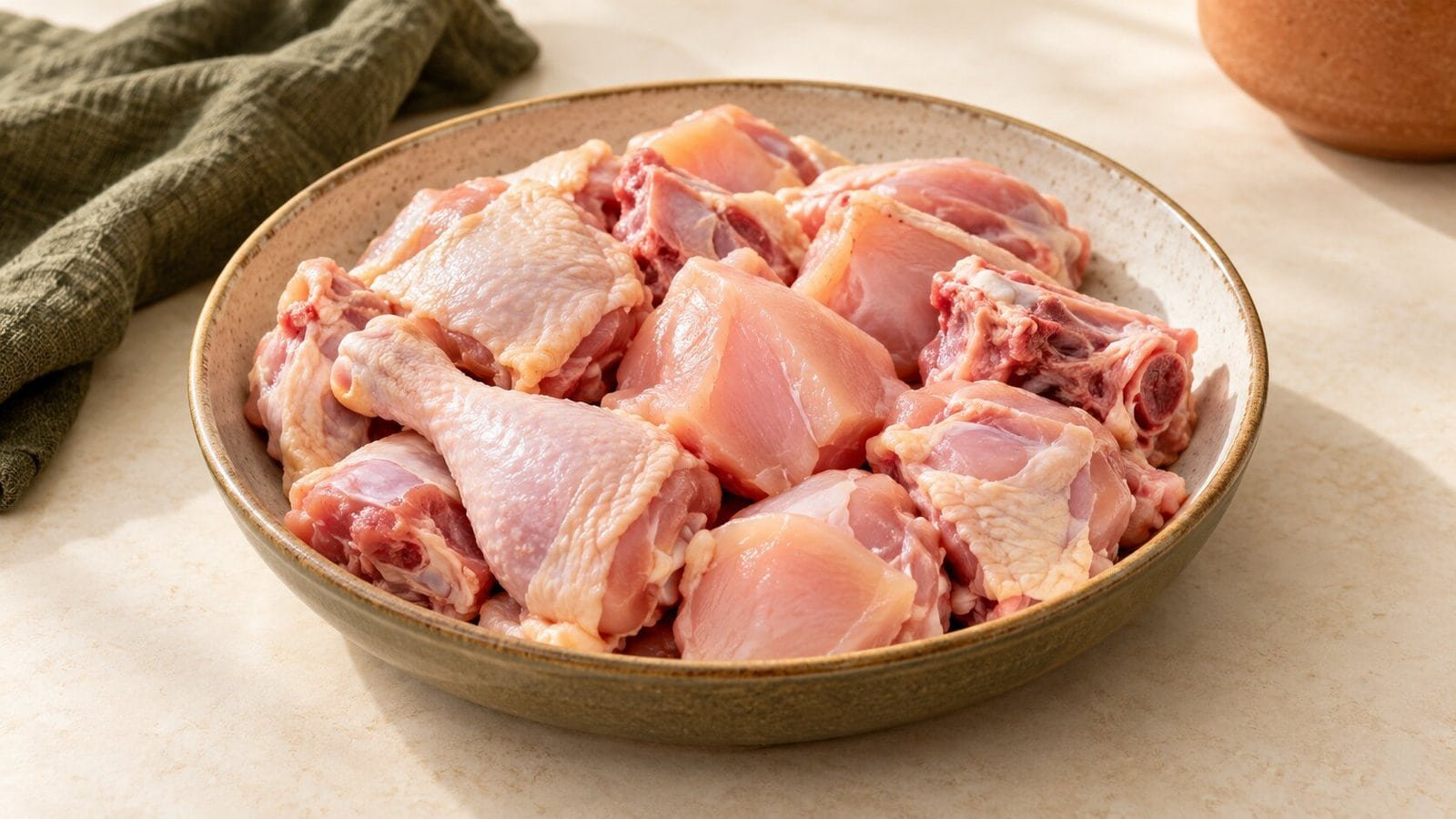
Buy 500 grams of chicken curry cut from two different shops and you may not get the same thing.
One pack might contain five or six fairly large pieces. Another could have more than a dozen smaller ones. One may include liver, while another leaves it out.
That is because curry cut is not one particular part of a chicken. It is chicken that has already been portioned into pieces for cooking. What ends up in the pack can vary more than the name suggests.
Quick Overview
- Curry cut usually contains a mix of chicken parts, rather than one anatomical cut.
- It may mean a whole chicken cut into pieces or a fixed-weight pack of mixed pieces.
- Piece count, bone, skin and offal can vary between products.
- When buying, the pack details tell you more than the words “curry cut” alone.
Curry Cut Is a Mix, Not a Particular Part
Names such as breast, thigh and drumstick tell you which part of the chicken you are buying.
Curry cut works differently.
It usually means chicken from several parts of the bird has been divided into smaller portions that are convenient for dishes such as chicken curry. Instead of getting only breast or only thigh, you generally get a mixture.
That can mean white meat, dark meat, bony pieces and different shapes in the same pack.
The differences between breast, thigh, drumstick, whole leg, wings and other chicken cuts in India are covered separately.
What Might Be in the Pack?
Depending on how the chicken has been divided, curry cut can contain pieces from the:
- breast
- thigh
- drumstick
- wings
- back or backbone
- neck
For example, Licious currently describes one 500 g curry-cut product as 12 to 14 bone-in pieces from the leg, breast and wings.
That is one seller’s version, not a rule every curry cut has to follow.
Does Curry Cut Mean a Whole Chicken?
Sometimes.
A butcher may take one dressed chicken and divide the bird into smaller pieces for curry. In that case, your curry cut comes from one whole chicken.
But retailers also sell fixed-weight packs of curry-cut chicken.
FreshToHome, for example, currently has a product specifically described as 1 Full Chicken Curry Cut as well as separate curry-cut packs sold by weight.
So these do not necessarily mean the same thing:
1 full chicken, curry cut
and:
500 g chicken curry cut
The first tells you that one bird has been portioned. The second tells you the quantity you are buying, but not necessarily whether every piece came from one complete chicken.
That difference can matter if you care about getting a particular balance of breast, leg, wings and other pieces.
Why Curry Cut Can Vary Between Sellers
Curry cut does not follow one fixed piece count or size. Current seller listings make that clear.
| Seller | Approx. quantity | Piece count | Key detail |
|---|---|---|---|
| FreshToHome | 440–450 g | 9–12 | Skinless medium pieces |
| Licious | 500 g | 12–14 | Bone-in pieces from leg, breast and wings |
| TenderCuts | 480–500 g | 5–6 or 16–18 | Piece count varies by cut option |
These examples were checked in September 2026. They are not definitions of curry cut. They simply show how differently the same term can be used.
A pack close to 500 g might contain only a few large pieces or well over a dozen smaller ones. That is why the piece count and product details are more useful than the words “curry cut” alone.
The need for extra detail appears outside retail listings too. A May 2026 ACTREC tender specified skinless curry-cut chicken and then separately excluded fat, liver and gizzard. Even there, the term needed additional details.
Note
A pack’s weight does not tell you its piece count or composition. Check both when those details matter.
Piece Size Matters More Than the Size Name
Labels such as small, medium and large can help, but they are most useful within one seller’s own range.
One shop’s medium curry cut does not have to match another shop’s medium.
Piece count often gives you a clearer picture.
If two packs weigh about the same and one contains six pieces while the other contains sixteen, the chicken has clearly been portioned very differently.
Smaller pieces
Smaller pieces give you more individual portions for the same overall weight.
They can work well when you want chicken distributed throughout the curry rather than a few large pieces.
If you compare the same type of chicken piece, a smaller one will also generally cook through sooner than a larger one.
Larger pieces
Larger cuts give you fewer, more substantial portions.
They may make more sense when you want recognisable pieces on the plate or when very small pieces would not suit the way the dish is being cooked.
So instead of relying only on small, medium or large, look at the piece count for the stated weight when the seller provides it.
There is one more wrinkle. Even pieces of similar size do not necessarily cook in exactly the same way.
A breast piece and a thigh piece are different muscles. A wing or backbone portion can also have a different balance of meat and bone.
That does not make mixed curry cut difficult to cook. It simply means a pack of similarly sized pieces is still a mix of different parts, so one universal cooking time for every curry cut would not be very useful.
Bone, Skin and Offal Are Separate Choices
Once you know you are buying curry cut, there are still a few other details that can change what you receive.
Bone-In or Boneless
Bone-in curry cut is common.
The Licious product above, for example, is explicitly sold as bone-in.
But seller terminology is not perfectly consistent. Farm Smart currently describes one of its curry-cut products as boneless portions.
So it is safer to treat bone-in as common rather than guaranteed.
If bone matters to the dish, check that detail directly.
Skin-On or Skinless
Both versions are sold.
TenderCuts currently offers separate skin-on and skin-off curry-cut options.
You may therefore see:
- skinless curry cut
- curry cut with skin
The curry-cut label itself does not decide which one you are getting.
Liver and Gizzard
Liver and gizzard are edible offal, not chicken cuts such as breast or thigh.
Some packs include them and others do not.
TenderCuts currently lists a regular curry cut with one liver piece, while premium versions are sold without liver. FreshToHome’s medium curry-cut listing specifically says there is no liver or gizzard.
If you have a preference, this is another detail worth checking rather than assuming.
Look Past the Name Before You Buy
You do not need to decode every detail on the label. A few checks usually tell you what matters most:
- How many pieces are there for the stated weight?
- Is it bone-in or boneless, and skin-on or skinless?
- Does the seller say which parts are included?
- Are liver, gizzard, neck or backbone included or excluded?
A 500 g pack containing six large bone-in pieces is a very different purchase from a 500 g pack containing sixteen smaller ones, even though both can be sold as curry cut.
Curry cut is useful shorthand. The pack details tell you what that shorthand means in practice.