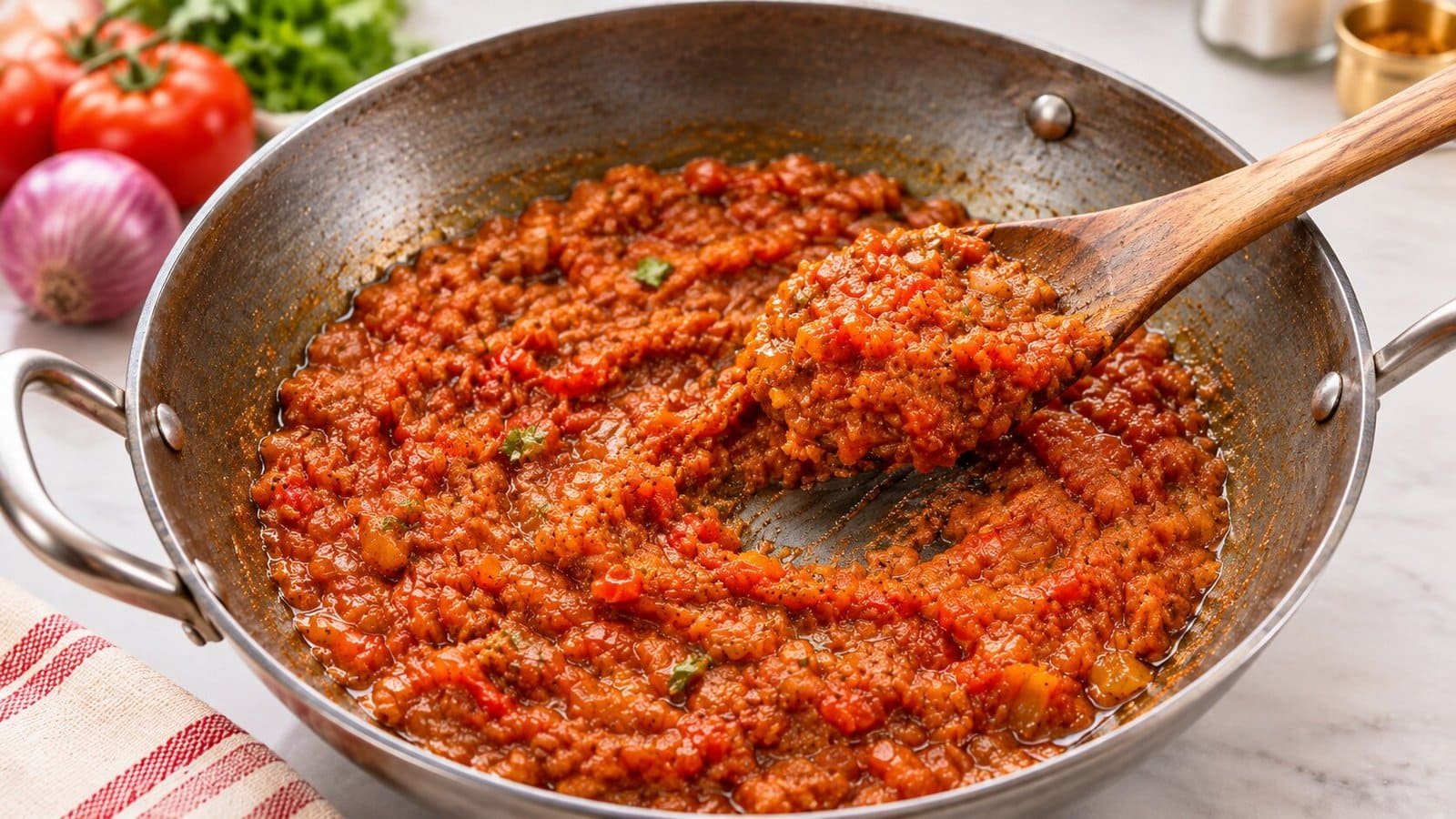
The tomatoes have softened into the onions. The masala is thicker than it was a few minutes ago, and your spoon leaves a trail through the pan. But there is no obvious pool of oil around the edges.
So, is it cooked?
Quite possibly.
Oil separation is useful when it happens, but it is not the only thing worth watching. A masala also changes in moisture, texture, bubbling, and how completely the ingredients come together.
For an onion-tomato masala, changes in moisture and texture usually tell you the most. Oil, aroma, color, and the clock can help confirm what you are seeing.
First, What Kind of Masala Are We Talking About?
Here, “masala” mainly means the common onion-tomato base used in many Indian curries: onions cooked with ingredients such as ginger, garlic, tomatoes, ground spices, and oil.
You may also hear instructions to bhuno or bhunao the masala. Broadly, this means cooking and stirring the mixture so moisture reduces and the ingredients develop into a more concentrated base. If it starts catching before it has cooked enough, a small splash of water may be used along the way.
Worth Knowing
A masala can be ready for the next stage of a particular recipe without producing a dramatic pool of oil. But when a recipe specifically tells you to bhunao until the oil separates, that oil release is part of the endpoint the recipe is asking for.
Not every masala reaches the same endpoint, either.
A yogurt-based masala behaves differently from an onion-tomato one. A ground coconut or nut paste can look different again.
For a typical onion-tomato masala, the pan gives you several useful clues.
Read the Masala in Stages
Instead of asking only, “Has the oil separated yet?”, look at what has changed since the tomatoes went into the pan.
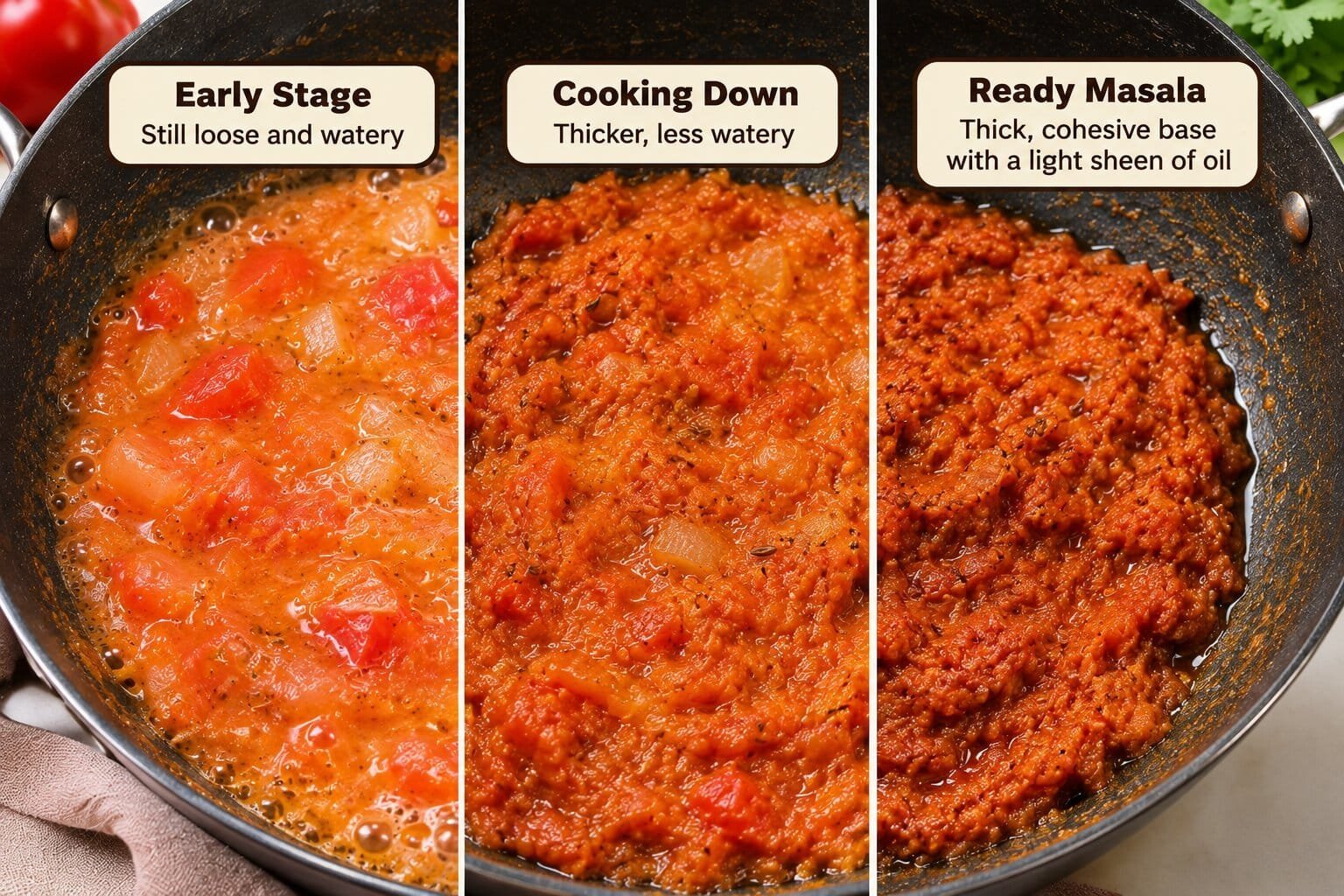
At First, Everything Still Looks Separate
Soon after adding tomatoes, the mixture can look quite loose.
You may still see individual pieces of tomato. Water released by the tomatoes collects around the onions, and the masala bubbles freely.
Move your spoon through it and the space usually fills back in straight away.
At this point, it generally needs more cooking.
The tomatoes may be hot and starting to soften, but the mixture has not yet cooked down into the thicker base you are looking for.
Keep the heat moderate enough that moisture can evaporate without the spices or onions catching on the bottom.
Then the Free Moisture Starts Disappearing
After a while, the masala begins to look less watery.
The tomatoes soften further and begin to blend more fully into the onion mixture. The bubbling changes too. Instead of looking loose and watery, the mixture starts bubbling through a thicker base.
Run the spoon across the bottom now and the masala may take a little longer to move back into the space.
That is a useful sign.
But soft tomatoes alone do not tell you the whole story.
Look at the mixture as a whole. Does it still spread around the pan like a wet tomato mixture, or is it beginning to hold together?
A Ready Masala Looks More Like One Mixture
As the masala cooks down, the onions and tomatoes begin to look more like one cohesive base rather than separate ingredients sitting together in the pan.
The mixture becomes thicker and holds together more readily.
Draw a spoon through it and the path may stay visible for a moment before the masala slowly moves back. Push it to one side of the kadai and it tends to hold together rather than immediately spreading into a watery layer.
You may also see some oil around the edges or a slight sheen on the surface.
Sometimes that is obvious. Sometimes it is barely more than a gloss.
In a simple Indian chicken curry, for example, this is the sort of stage you want before adding the chicken. The tomatoes have cooked into the onions, the mixture has thickened, and there is no large amount of loose tomato water sitting in the pan.
And Yes, You Can Cook It Too Far
Once most of the free moisture has gone, keep a closer eye on the pan.
The masala can move from nicely reduced to sticking fairly quickly, especially over strong heat.
A little sticking does not automatically mean something has gone wrong. But if the mixture is drying rapidly, darkening much faster than you intended, or leaving scorched patches underneath, turn the heat down.
And do not keep cooking just because you are still waiting for a dramatic ring of oil.
The rest of the pan may already be telling you it is time to move on.
Does the Oil Have to Separate From the Masala?
No. Not as a visible pool in every recipe.
Oil separation is still a useful cooking cue. As moisture reduces and the mixture becomes more concentrated, fat may become easier to see around the edges or on the surface.
How obvious that looks depends partly on how much oil is in the masala and how much moisture is still left to cook away.
Use a generous amount of oil and you may see a clear ring around the edges.
Use less, and the sign can be much quieter. You may only notice a slight sheen on the surface or small traces of oil around parts of the mixture.
If a recipe simply needs the onion-tomato base cooked down before the next ingredient goes in, waiting for a puddle that was never likely to appear can leave the masala cooking longer than necessary.
If the recipe specifically asks you to bhunao until the oil separates, though, follow that instruction. In that case, visible oil release is part of the cooking stage being called for.
For everyday onion-tomato masala, it is usually more useful to look at all the signs together.
If the tomato has softened into the base, loose moisture has reduced, the mixture is thick and cohesive, and some fat is becoming visible, you have a much better picture than oil alone can give you.
Other Clues Can Help, but They Shouldn’t Decide It Alone
Some familiar recipe instructions are useful. The problem comes when one of them is treated as a guaranteed finishing test.
Smell
Recipes often tell you to cook masala until the “raw smell” disappears.
That can help, but smell is difficult to use as a precise endpoint on its own.
Ginger, garlic, tomato, chilli, coriander powder, and other ingredients all change as they cook. What one cook notices as a raw smell may not be especially obvious to someone else.
Use aroma alongside what you can see in the pan.
If the masala still has plenty of loose tomato water and the onions and tomatoes still look largely separate, a pleasant aroma does not mean it has finished reducing.
Cooking Time
A recipe may tell you to cook the masala for 8 minutes, 10 minutes, or 15 minutes.
Treat that number as a guide.
Juicier tomatoes bring more water. A larger batch takes longer to reduce. A broad kadai exposes more surface area than a narrow pot, so moisture can leave the two at different rates. Burner strength matters too.
If ten minutes have passed and the masala is still obviously watery, keep cooking.
If it has already become cohesive and is starting to catch earlier than expected, do not keep frying just to reach the stated time.
The clock helps. The pan tells you more.
Color
A masala often becomes darker as it cooks, but color can fool you.
Kashmiri chilli powder can make it look richly red quite early. Turmeric changes the appearance immediately. Deeply browned onions can darken the entire mixture before the tomatoes have reduced properly.
So darker does not automatically mean done.
Look at color together with moisture and texture.
The same goes for glossiness. Plenty of oil can make a masala look glossy even while the tomato mixture is still loose.
What If the Masala Starts Sticking Before It Looks Ready?
This is where the pan can get a little confusing.
The masala starts catching on the bottom, so it feels as though it must be done.
Not necessarily.
It may simply be getting more heat than the remaining moisture can handle.
If the Masala Is Catching Too Soon
Lower the heat first. If the spices or tomato are catching before the ingredients have softened and come together, add a small splash of water, perhaps a tablespoon or two, and scrape the browned masala back into the mixture. Then keep cooking.
That small amount of water gives the mixture a little more time without turning it back into a thin sauce.
A large pour is different. Add half a cup and you have created more liquid that will need to cook away again.
If the bottom has actually scorched, though, water will not remove the burnt flavor. Avoid scraping blackened material back through the masala.
The Cues Change When the Masala Changes
The signs above work best for an onion-tomato curry base. Change the ingredients and you need to change what you look for.
Onion-heavy masalas
With very little tomato, there may be less of an obvious wet-to-thick change.
The onions’ softness and browning, the reduction of added moisture, and the way the ground spices combine with the base become more useful clues.
Tomato-heavy masalas
Very ripe or plentiful tomatoes can keep the mixture loose for longer.
Here, the disappearance of obvious free tomato water becomes especially useful to watch.
Masalas with yogurt
Yogurt brings additional water and proteins, so heat control matters as well as reduction. If yogurt is going into the base, how you add yogurt to curry can make the difference between a smooth mixture and one that splits.
A yogurt masala should not be expected to look exactly like a simple onion-tomato base.
Coconut, Nut, or Seed Pastes
Ground coconut, nuts, or seeds can change both the thickness of the masala and how visible the fat becomes.
That means thickness alone tells you less. The particular recipe and ingredients matter more than trying to make the mixture look like a tomato-based masala.
Once you know what kind of masala is in the pan, the judgment gets easier.
For an onion-tomato base, pay most attention to whether the loose moisture has reduced and the ingredients have come together into a thicker, cohesive mixture.
If oil appears around the edges, useful. If all you see is a light sheen, that can be enough too.
It is one clue, not the whole answer.