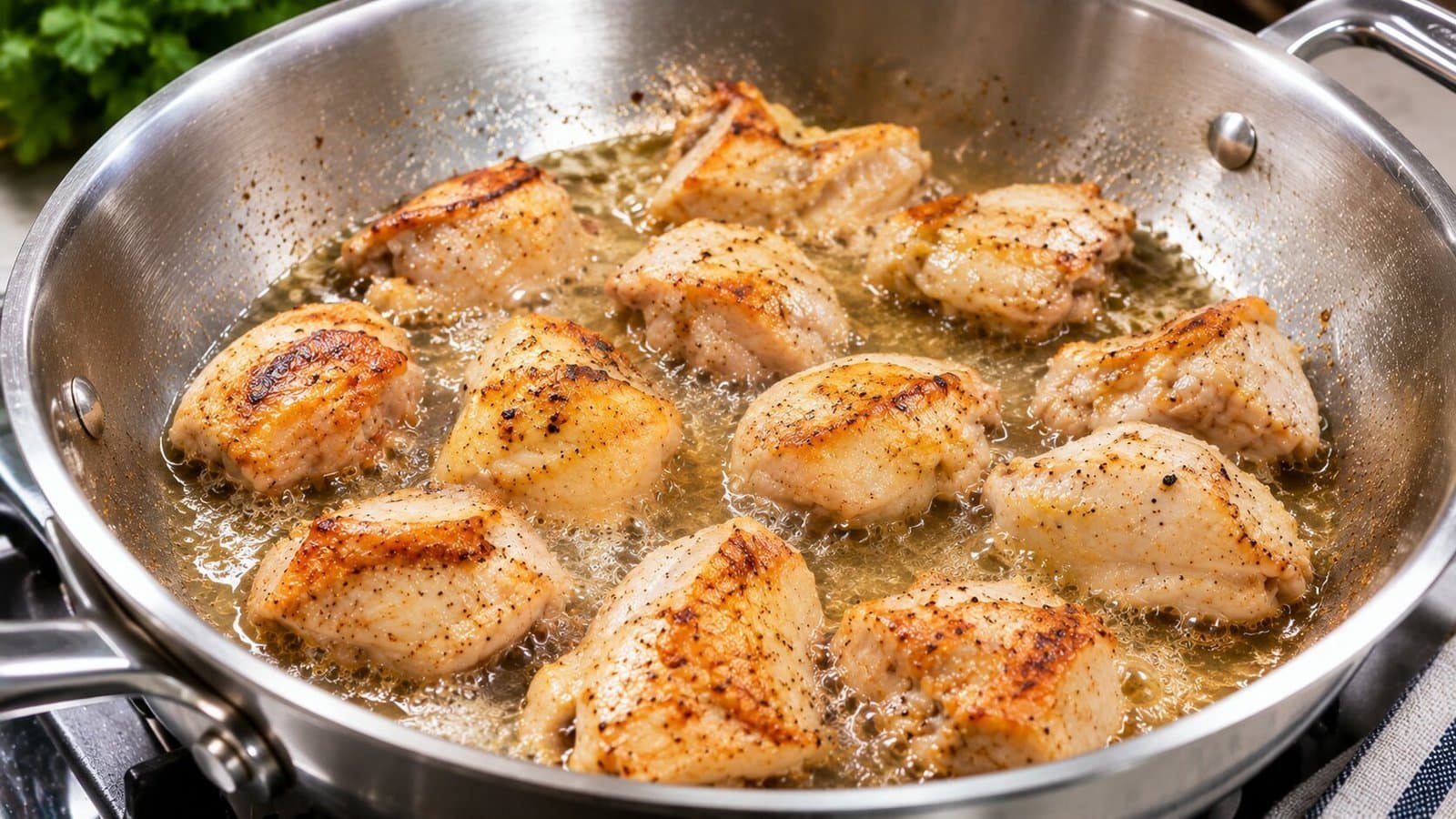
You put chicken into a hot pan expecting it to start cooking against the surface. A few minutes later, there is liquid around the pieces and the sizzling has turned into something closer to simmering.
That does not automatically mean anything is wrong with the chicken.
Some moisture coming out during cooking is normal. The important part is whether that moisture evaporates or starts collecting around the chicken.
What you do next depends on the result you want. Chicken that needs to brown and chicken going into a curry do not need exactly the same response.
Some Water Coming Out of Chicken Is Normal
Chicken naturally contains a lot of water.
As it heats, changes in the muscle proteins reduce how much moisture the meat can hold, so some liquid loss during cooking is normal.
Worth Knowing
A little water appearing around the chicken is not, by itself, a problem. The trouble starts when moisture reaches the pan faster than it can evaporate.
Why Does the Pan Sometimes Fill With Water?
Two things are happening at once.
The chicken is releasing moisture.
The hot pan is trying to evaporate it.
When evaporation keeps up, the pan stays relatively dry and the chicken can move toward browning.
When it cannot keep up, liquid starts collecting.
Several things can push the pan in that direction.
There Is Too Much Chicken in the Pan
A crowded pan has to deal with a lot of moisture at once.
Adding a large batch also pulls heat from the pan. If the pan does not recover quickly enough and evaporation cannot keep pace, the released liquid begins to collect around the chicken.
That is why crowding matters when browning is the goal.
It is not simply about whether the pieces are touching. The pan needs enough heat and enough opportunity for moisture to leave.
The Chicken Is Already Wet on the Outside
Not all the water in the pan necessarily came from inside the meat.
There may be liquid from the packaging clinging to the surface. A wet marinade can add more.
If you want the chicken to brown, that surface moisture has to evaporate first.
Patting excess surface moisture from plain chicken before it goes into the pan can help.
If you usually wash chicken before cooking, that also leaves more surface water to deal with. For browning, the immediate cooking issue is simple: that extra moisture has to evaporate first.
Thawed Chicken Can Lose More Liquid
Ever defrosted chicken and noticed liquid collecting in the container?
Freezing and thawing can reduce the meat’s ability to retain moisture. Research on chicken breast has found that repeated freeze-thaw cycles reduce water-holding capacity and increase moisture loss.
Thawed chicken will not always flood the pan, but it can sometimes give you more drip or lose moisture more readily, depending on how it was frozen, stored, and thawed.
If there is plenty of liquid around thawed chicken before cooking, discard any liquid in the package and pat away excess surface moisture if browning is the goal.
A Narrow or Crowded Pan Can Slow Evaporation
Pan shape matters too.
A broad frying pan or kadai exposes more liquid to the air than a narrow, deep vessel, so moisture can usually cook away faster.
That does not make a narrow pot wrong. A curry may cook perfectly well in it.
But if you are wondering why chicken is simmering in liquid instead of browning, the amount of chicken, the pan’s heat, and the available surface area are all worth looking at.
If You Want the Chicken to Brown, the Water Has to Go First
Suppose the chicken is meant to brown, but there is already a layer of liquid across the bottom of the pan.
Adding more oil is tempting.
For Better Browning
Adding more oil will not make the water disappear. As long as the surface of the chicken and the pan around it remain very wet, strong browning is difficult. The first job is to let that moisture evaporate.
- Keep the pan uncovered.
- If it is badly crowded, move some pieces to another hot pan or cook in batches rather than trying to force all of them to brown at once.
- Give the liquid time to cook away before deciding the pan needs more fat.
Once most of the visible water has gone, the sound often changes too. The gentler bubbling of liquid gives way to a sharper sizzle as the chicken makes more direct contact with the hot surface.
That is when browning has a much better chance.
If You’re Making Curry, the Situation Is Different
Now put the same chicken into cooked onion-tomato masala instead of an empty frying pan.
Some moisture comes out.
Do you need to get rid of all of it?
Not necessarily.
In a curry, the chicken is eventually going to cook with liquid anyway. Moisture released from the meat can become part of the developing gravy.
The thing to watch is how much is already in the pan before you add more.
If the chicken has released enough liquid to loosen the masala and begin a gentle simmer, you may need less added water than you expected.
Give it a few minutes and look.
- Is the masala still fairly thick around the chicken? Add some hot water if the curry needs it.
- Has plenty of liquid already collected? Let the chicken cook in that first and decide later whether more is actually necessary.
In a simple Indian chicken curry, giving the chicken a few minutes in the masala before deciding how much water to add lets you account for the moisture already in the pan.
That small pause can prevent the curry from becoming thinner simply because a fixed quantity of water was added automatically.
Once the chicken is cooked and the finished gravy itself is still thinner than you want, the problem has changed. At that point, why a curry stays watery and how to fix it depends on the overall amount of liquid, reduction, and body in the gravy rather than only on moisture released by the chicken.
Does Lots of Water Mean the Chicken Is Poor Quality?
Not from that observation alone.
Chicken naturally contains plenty of moisture, and how much it loses can vary with the meat itself, storage, freezing and thawing, processing, and cooking conditions. Poultry’s water-holding capacity can be affected by several biological and processing factors.
Some packaged marinated or seasoned chicken may also contain added liquid, depending on how the product is prepared and sold.
But seeing water in your kadai is not enough to conclude that plain chicken has been injected with water or that the seller gave you poor-quality meat.
If the packaging says the chicken is marinated, seasoned, brined, or contains an added solution, the label is a better place to check than trying to diagnose the meat from one pan.
The next time chicken suddenly leaves a pool of liquid in the pan, look at what you need it to do next. If you are trying to brown it, give that moisture enough heat and space to evaporate. If you are making curry, count the liquid already in the pan before adding more.