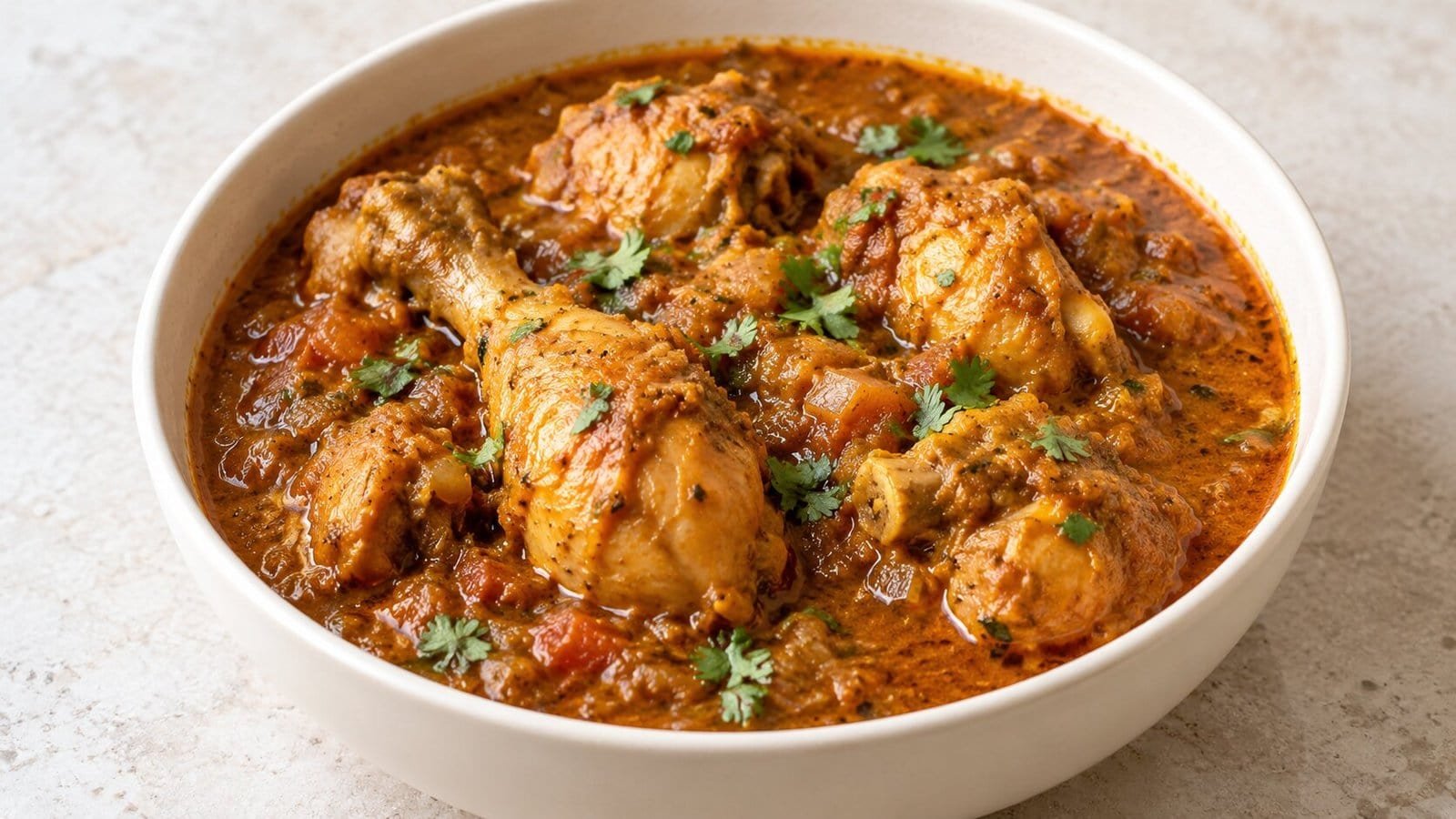
A good everyday Indian chicken curry does not need cream, coconut milk, yogurt, or a long spice list.
Here, the gravy starts with onions and tomatoes cooked down with ginger, garlic, cumin, and a few ground spices. The chicken goes in before the water, which gives you a chance to see how much moisture is already in the pan before deciding how much gravy to make.
This is not meant to represent one particular regional chicken curry. It is a straightforward stovetop version with a medium-bodied gravy that works with both roti and rice.
Ingredients
For about 4 servings:
- 750 g skinless, bone-in curry-cut chicken
- 3 tablespoons neutral cooking oil
- 1 teaspoon cumin seeds
- 2 medium onions, about 220–250 g, finely chopped
- 1–2 green chillies, slit
- 1½ tablespoons ginger-garlic paste
- 2 medium tomatoes, about 200–250 g, finely chopped or grated
- ½ teaspoon turmeric powder
- 1 teaspoon Kashmiri red chilli powder
- 2 teaspoons coriander powder
- 1 to 1¼ teaspoons fine salt to start, plus more if needed
- Up to 250 ml hot water
- ¾ teaspoon garam masala
- 2 tablespoons chopped fresh coriander
Kashmiri chilli powder works well when you want color without making the curry especially hot. If the chilli powder you use at home is stronger, reduce the amount rather than following the measurement rigidly.
Before the Pan Goes On
Bone-in curry cut works well for this style of curry because the pieces can simmer directly in the gravy. Since the mix and size of curry-cut pieces can vary between sellers, try to choose pieces that are reasonably similar in size.
Many households wash raw chicken before cooking. It is not necessary for food safety, and washing it under running water can spread contaminated droplets around the kitchen. If you still prefer to wash it, use a gentle flow of water and clean the sink and surrounding area thoroughly afterward.
Have the onion, tomato, ginger-garlic paste, and spices ready before you start. Once the masala is cooking, it is easier to watch the pan than stop to measure the next ingredient.
Keep the hot water nearby too, but do not assume you will need all 250 ml. The chicken, onions, and tomatoes already contribute moisture.
How to Make the Chicken Curry
1. Take the onions past soft
Heat the oil in a kadai, deep frying pan, or heavy saucepan over medium heat.
Add the cumin seeds and let them sizzle for 20–30 seconds, just until fragrant. Add the onions and green chillies.
Cook the onions over medium heat, stirring regularly, until they are soft and evenly golden. Around 8–12 minutes is a useful guide, but the color matters more than the clock.
Pale, softened onions need more time. Dark brown onions have gone further than this curry needs.
If the edges are browning much faster than the rest, lower the heat. Browned bits catching on the pan can be loosened with a small splash of water.
2. Let the tomato masala cook down properly
Add the ginger-garlic paste and stir for about a minute.
Add the tomatoes, turmeric, Kashmiri chilli powder, coriander powder, and 1 teaspoon of salt.
The mixture will be fairly loose at first. Keep cooking over medium heat until the tomatoes have softened into the onions and the masala looks thicker and more cohesive, with less free moisture in the pan.
Depending on the tomatoes, heat, and pan, this may take around 8–12 minutes.
Do not use a pool of separated oil as your only sign that the masala is ready. With a moderate amount of oil, you may see only a light sheen around the edges. The bigger clues are that the tomatoes no longer look separate, the mixture has thickened, and the masala holds together more readily when you move it with the spoon.
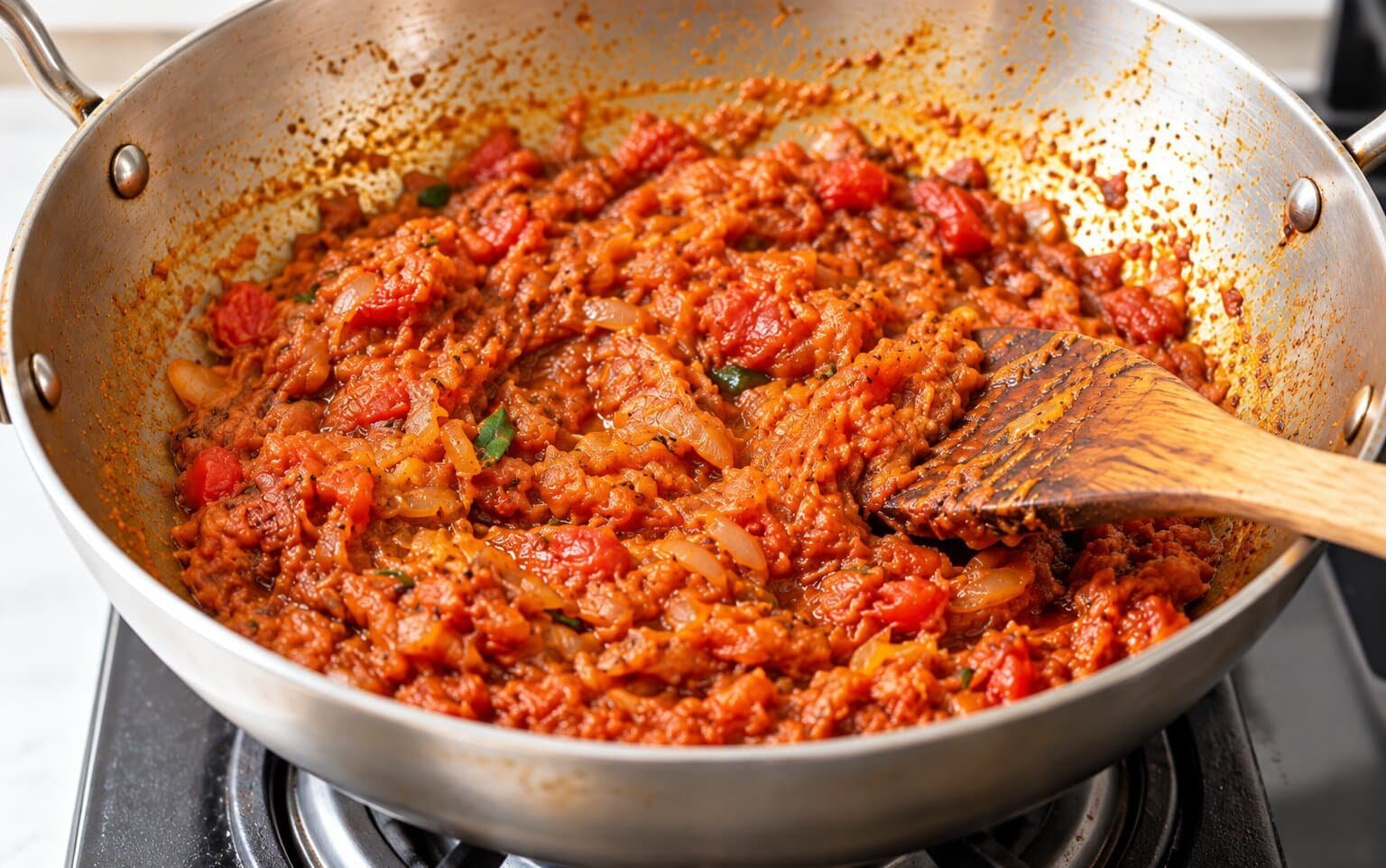
Spices catching before the tomatoes are ready? Add one or two tablespoons of water and keep cooking rather than letting the masala scorch.
3. Give the chicken some time in the masala
Add the chicken and turn the pieces through the masala until they are well coated.
Cook for around 5–7 minutes over medium to medium-high heat, turning the pieces occasionally.
As the chicken heats, some liquid may collect in the pan. Check how much is there before adding water.
That is the useful part of waiting. You can decide how much extra liquid the curry actually needs instead of choosing the gravy consistency in advance.
4. Add the water in stages
Start with about 200 ml of hot water.
Stir well and scrape any masala from the bottom of the pan back into the gravy. Bring everything to a gentle simmer.
Now judge the amount of liquid in the pan.
Enough for the chicken to simmer comfortably? Leave the remaining water out.
Still too thick? Add a little more.
You may use the full 250 ml, but there is no advantage in adding it simply because it was measured. It is much easier to loosen a thick gravy than reduce one that started with too much water.
5. Simmer gently until the chicken is cooked
Lower the heat and cover the pan.
Let the chicken simmer gently, stirring once or twice so the gravy does not catch on the bottom.
Typical curry-cut pieces may take roughly 15–20 minutes once the gravy is simmering, but piece size, pan shape, and heat can change that.
Use the time as a guide rather than proof that the chicken is done.
Food Safety
Cook the chicken to an internal temperature of at least 75°C. Check the thickest part of a large piece and keep the thermometer probe away from the bone.
6. Finish the gravy by looking at what is in the pan
Remove the lid once the chicken is cooked.
If the gravy is looser than you want, let it simmer uncovered for a few minutes before reaching for a thickener.
Already-cooked smaller pieces can be taken out temporarily while the sauce reduces. That keeps you from overcooking the chicken just to fix the gravy.
When reduction still does not give the sauce enough body, the problem may be more than excess water. A curry can stay thin because the gravy itself does not have enough body.
A gravy that has become too thick is easier to correct. Add hot water one or two tablespoons at a time, let the curry return to a simmer, and check again.
Once the consistency is where you want it, taste for salt.
Stir in the garam masala and cook for another minute, then turn off the heat and add the fresh coriander.
Give the curry about 5 minutes to settle before serving.
Using Boneless Chicken Instead
You can make the onion-tomato masala the same way with boneless chicken, but do not automatically follow the bone-in cooking time.
Boneless pieces generally cook sooner, so start checking them earlier.
Chicken breast deserves a little more attention because it can dry out with prolonged cooking. If the meat is already cooked but the gravy still needs reducing, take the chicken out and finish the sauce separately.
What Goes Well With It
Serve the curry with:
- steamed rice
- jeera rice
- roti or chapati
- paratha
Storing and Reheating Leftovers
Once you have finished serving, move the leftovers to a clean, covered container. Cooked meat and poultry should be refrigerated within two hours.
When reheating, stir the curry so the chicken heats evenly.
The gravy may become thicker in the fridge. Start with a small splash of water while reheating, then add more only if the sauce still needs loosening.