
You expected the curry to finish with a proper gravy, but there is still a pool of thin liquid around the chicken, paneer or vegetables.
Reaching straight for cornflour may seem like the quickest fix. Often, it is not the best one.
A watery curry can happen because too much liquid ended up in the pan, the sauce has not reduced enough, or there is not enough giving the gravy its body. Sometimes the curry is not actually wrong at all. It may simply be a naturally looser style.
The useful question is not only “How do I make this thicker?” It is “Why is it watery?”
Quick Overview
- First check whether the curry is actually meant to be thicker.
- If the sauce tastes right but is too loose, simmer it uncovered first.
- If reduction is not enough, add body in a way that suits the curry.
- If the curry is already salty or strongly spiced, reduce carefully so the flavor does not become too concentrated.
Why Did My Curry Turn Watery?
Two curries can look equally thin but need completely different fixes.
Start with what happened in your pan.
Too Much Liquid Ended Up in the Pan
Sometimes you simply add more water or stock than the curry needs.
Other times, the amount looked fine at first, but the chicken, meat, tomatoes or vegetables released more moisture as they cooked.
Meat and poultry naturally contain a lot of water, and some of that moisture is lost during cooking. The USDA explains how water behaves in meat and poultry.
In a curry, some of that moisture ends up in the pan before it eventually cooks away.
Vegetables can do the same thing and sometimes release more water than you expect.
That is why it is often easier to add more liquid later than to start with too much. If a recipe gives you a range, you may not need the full amount straight away.
The Curry Hasn’t Reduced Enough
Sometimes the proportions are fine. The curry just needs more time.
A lid keeps moisture in the pan. That helps while ingredients are cooking, but it also slows evaporation.
If everything is cooked and the gravy still looks too loose, removing the lid and simmering a little longer may be enough.
Pan shape can make a difference too. A wide pan exposes more sauce to the air than a narrow, deep pot, so water usually cooks away faster.
The Sauce May Lack Body
A curry can still feel thin even when there is not an obvious excess of water.
The sauce may simply need more of whatever is meant to give that particular dish its body, whether that is cooked onion and tomato, lentils, coconut, nuts or another ingredient.
If reasonable reduction is not improving the texture, stop focusing only on the water and look at the sauce itself.
The Curry May Not Actually Be Wrong
Before changing anything, think about the kind of curry you are making.
Indian curries do not all finish with the same consistency.
Some gravies are thick enough to cling heavily to the ingredients. Others are meant to be thinner and more pourable, especially when served with rice.
A curry does not need to look like a rich restaurant-style gravy to be properly cooked.
If the flavor is balanced and the consistency suits the dish, you may not need to fix anything.
First Decide What Kind of Fix You Need
Look at both the texture and the flavor before adding anything.
| What you notice | What may be happening | Best first move |
|---|---|---|
| Sauce tastes good but is simply too loose | Excess liquid | Simmer uncovered |
| Curry tastes diluted as well as thin | Too much liquid or not enough reduction | Reduce, then taste again |
| Curry became wetter after adding chicken, meat or vegetables | Ingredients released moisture | Cook uncovered before adding more liquid |
| Sauce remains thin after reasonable reduction | It may lack body, or the dish may naturally be thin | Check the sauce base before adding a thickener |
| Curry is already salty, sour or strongly spiced | More reduction could over-concentrate the flavor | Add body in a way that suits the dish |
If There Is Too Much Liquid, Reduce It First
If the curry already has a good masala base and tastes the way you want, reduction is usually the least disruptive fix.
Remove the lid and let the curry simmer so some of the water can evaporate.
You do not need a hard boil. A steady simmer gives you more control and makes it easier to stop when the gravy reaches the consistency you want.
Stir from time to time, especially as the sauce gets thicker. A curry that looked very loose a few minutes ago can start catching on the bottom once enough water has cooked away.
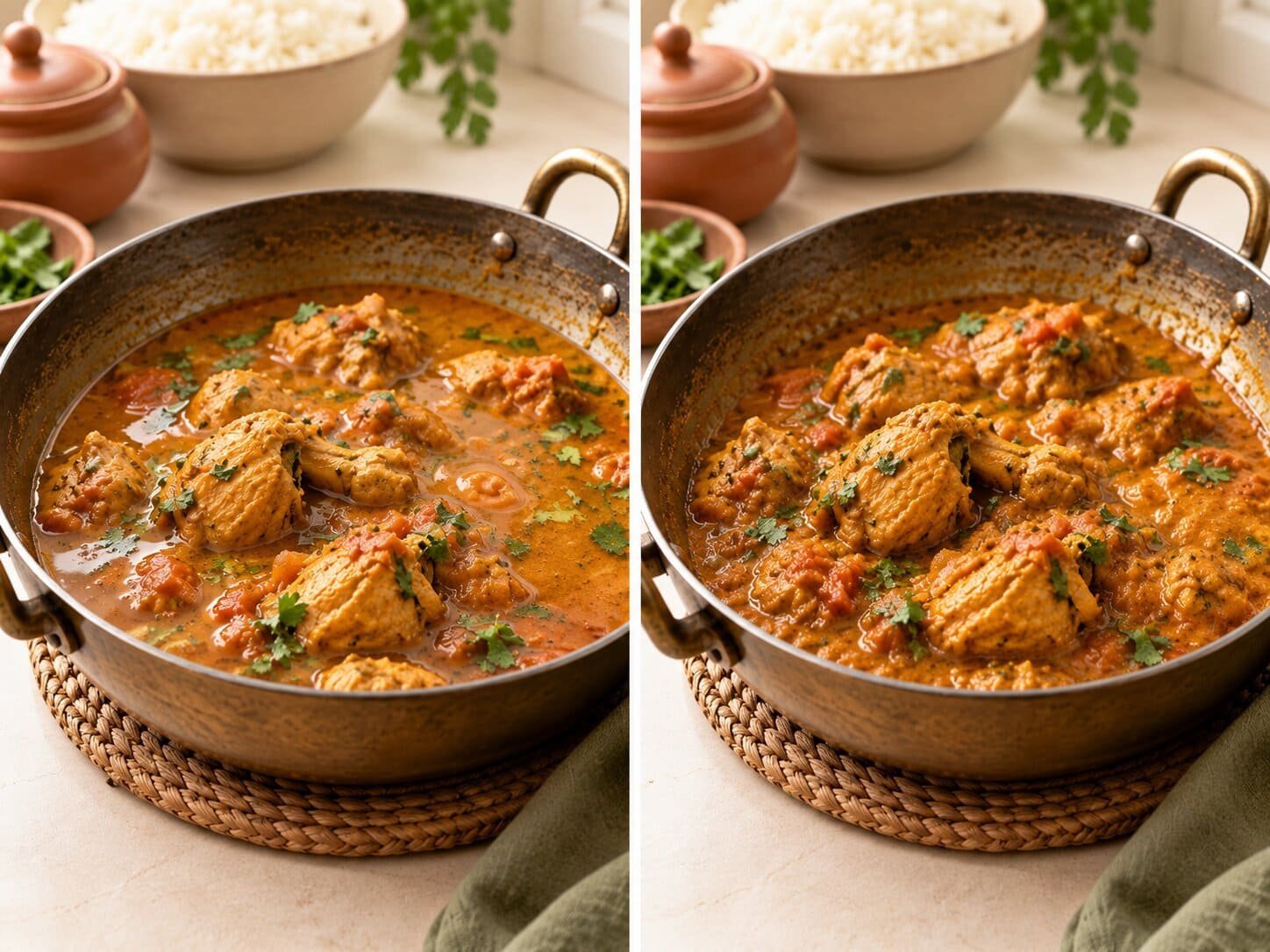
What If the Chicken, Paneer or Vegetables Are Already Cooked?
The sauce may need more time even when the rest of the curry does not.
If the chicken, paneer or vegetables are already where you want them, take them out for a few minutes.
Reduce the sauce on its own, then return them once the gravy is right.
You are fixing the sauce without making the rest of the curry pay for it.
If the Curry Lacks Body, Reduction May Not Be Enough
A curry can lose water and still feel thin.
If the sauce itself does not have much structure, simmering it for longer may not give you the texture you were expecting.
Think about what normally gives that curry its body.
In one dish, that may be a cooked onion-tomato base. In another, it may be lentils, coconut, nuts, yogurt or vegetables softening into the sauce.
If one of those ingredients is supposed to do more of the work, adding flour is not automatically the answer.
Before adding anything, ask what normally gives that particular curry its body.
When Adding Body Makes More Sense
Sometimes you do need to add something. Just make sure it makes sense for the curry you are cooking.
Ground nuts or seeds can give a sauce a lot more body, but they also add richness and their own flavor. They work best when those flavors already belong in the dish.
Coconut milk, coconut cream or ground coconut can make a sauce fuller and richer. That works well in curries where coconut is already part of the flavor. In another dish, it may change the curry more than you want.
Yogurt can add body, richness and tang, but it is not a neutral thickener. If yogurt suits the curry, add it carefully so you do not trade a watery sauce for a split one. The method changes depending on whether the yogurt is finishing the sauce, cooking into the masala or forming the curry base. See how to add yogurt to curry without curdling.
Besan, cornflour and other starches can thicken liquid quickly, but they also change the finished texture. Besan brings its own flavor too.
If you use cornflour or another starch that needs a slurry, mix it with cool liquid first so it blends into the curry smoothly rather than forming lumps. University of Illinois Extension explains the same basic principle in its guide to how starch thickens sauces.
Add a little at a time. Too much can take a sauce from watery to gluey very quickly.
You may not need to add anything new at all. If the curry already contains lentils, beans or soft cooked vegetables, mashing or blending a small portion and stirring it back in can sometimes give the sauce more body without changing its basic flavor.
Be Careful Before You Keep Reducing
Reduction removes water. It does not remove salt, chilli, spices or acidity.
As the sauce gets smaller in volume, those flavors become more concentrated.
That can be a problem if the curry is already:
- slightly too salty
- very hot
- noticeably sour
- heavily seasoned
Taste before you keep reducing for a long time.
If the seasoning is already intense, adding body in a way that suits the curry may be safer than boiling away a large amount of water.
It is also worth waiting before you keep correcting the seasoning.
A watery sauce may taste bland simply because it has not reduced yet. Add more salt or chilli too early, and the finished curry can end up over-seasoned once the extra water is gone.
Let the sauce get close to its final consistency, then taste again.
How to Avoid a Watery Curry Next Time
A few small habits make the final consistency easier to control:
- Add liquid gradually when the recipe allows it.
- Give chicken, meat and moisture-rich vegetables time to release their own water before adding more.
- Use the lid deliberately: cover when you want to retain moisture, uncover when you need the sauce to reduce.
- Make final seasoning adjustments once the gravy is close to the consistency you want.
If your curry looks watery, do not assume it needs a thickener.
Often, it simply needs a little more time uncovered. When it needs something else, use the fix that still makes sense for the curry you are actually cooking.