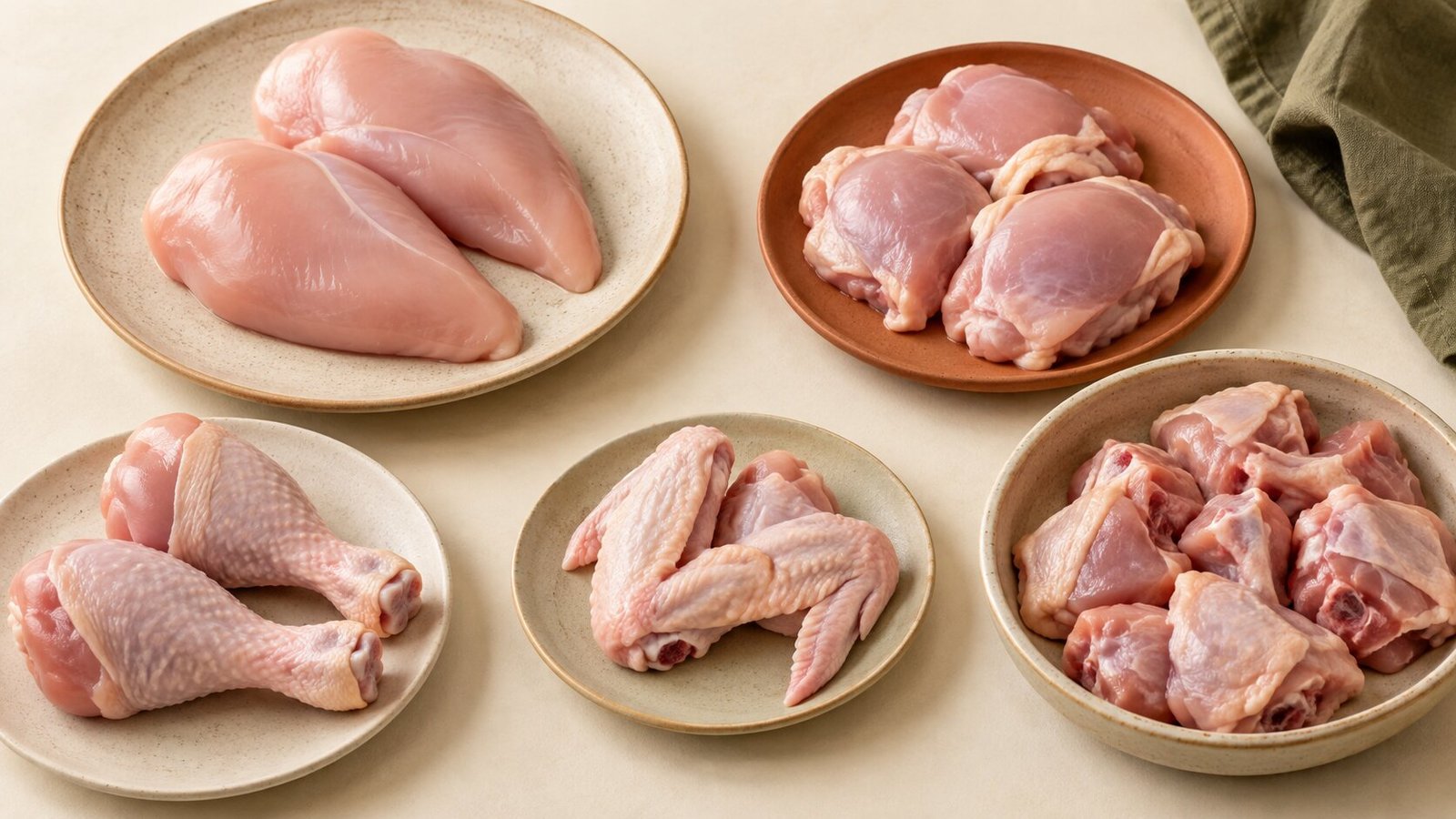
Buying chicken can get confusing surprisingly quickly. One shop lists breast, thigh and drumsticks. Another offers curry cut, biryani cut, boneless cubes and whole leg. Then you see choices such as skinless, bone-in, small cut and large cut added to the mix.
These names are not all describing the same thing.
Some tell you which part of the chicken you are buying. Others describe how the chicken has been cut for cooking. Details such as bone, skin and piece size add another layer.
Once you know what each part of the label is telling you, choosing the chicken you actually want becomes much easier.
Quick Overview
- Breast, thigh, drumstick and wings name physical parts of the chicken.
- Curry cut and biryani cut describe how chicken has been portioned for cooking.
- Bone-in, boneless, skin-on, skinless and piece size are separate details that can be added to those names.
- Retail definitions can vary, so check the actual pack details when piece size or composition matters.
Chicken Labels Tell You Different Things
It helps to sort the names you see at a butcher or on a meat-delivery app into four groups.
| Type of label | Examples | What it tells you |
|---|---|---|
| Anatomical part | Breast, thigh, drumstick, wing, tenderloin | Which part of the chicken the meat comes from |
| Combined portion | Whole leg | Which parts have been left attached |
| Prepared format | Curry cut, biryani cut, lollipop | How the seller has portioned or prepared the chicken |
| Additional detail | Bone-in, boneless, skin-on, skinless, small pieces, cubes | How that particular product has been finished or sized |
For example, skinless bone-in curry cut, large pieces does not name one specific part of a chicken.
Curry cut describes the way the chicken has been portioned. Skinless means the skin has been removed. Bone-in means the bones remain. Large pieces tells you about the size.
India’s Food Safety and Standards Authority also distinguishes dressed chicken sold as carcasses, bone-in or boneless cuts, and edible offal rather than treating everyday retail names such as curry cut as anatomical categories.
The Main Parts of a Chicken
You do not need to know every butcher’s term to shop confidently. A handful of basic cuts cover most of what you will see.
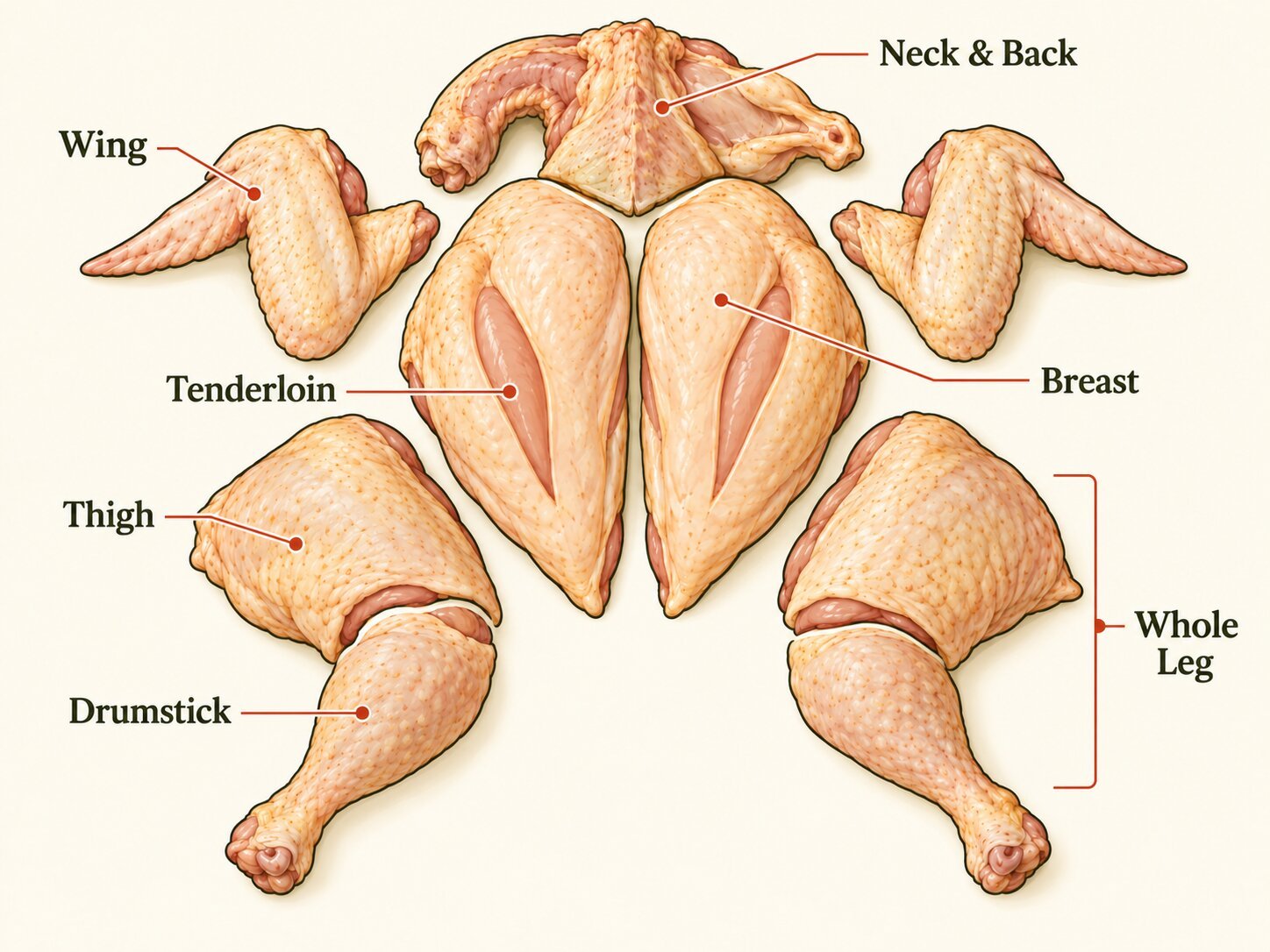
Kerala SCERT’s food and restaurant management material identifies chicken parts including breast, thigh, drumstick, wings and neck, and its accompanying diagram also shows tenderloin, whole leg and whole chicken.
| Cut | Where it comes from | What you are generally buying |
|---|---|---|
| Breast | Chest | A large portion of white meat, sold bone-in or boneless |
| Tenderloin | Beneath the breast | A narrow strip of boneless meat |
| Thigh | Upper leg | Dark meat, sold bone-in or boneless |
| Drumstick | Lower leg | The familiar bone-in lower-leg portion |
| Whole leg | Thigh + drumstick | Both leg sections left attached |
| Wing | Wing | Sold whole or divided into smaller sections |
| Neck and back | Carcass | Bone-rich portions that may appear in mixed packs |
| Whole chicken | Entire dressed bird | Chicken sold whole rather than portioned into individual cuts |
Breast, Tenderloin and Thigh
The breast is the large chest portion. The tenderloin is the smaller strip of meat attached beneath it. The thigh comes from the upper leg.
You may find all three sold boneless, but they are not interchangeable simply because the bones have been removed. Breast and thigh differ enough in texture and cooking behaviour that knowing which one you are buying can matter to the finished dish.
Drumstick and Whole Leg
A drumstick is only the lower part of the leg.
A whole leg keeps the thigh and drumstick attached.
Everyday wording can be less precise. “Leg piece” may mean a drumstick in one shop or household, while another seller may use similar wording for a larger leg portion.
If the distinction matters, asking for drumstick, thigh or whole leg is clearer than relying on “leg piece.”
Wings and Chicken Lollipops
A wing is a physical part of the chicken. A chicken lollipop is a prepared wing portion.
The meat is worked toward one end of the bone, creating the exposed handle and rounded meat portion that gives the lollipop its shape.
So although you may see lollipops listed beside drumsticks or wings, they are a preparation style rather than a separate part of the bird.
Curry Cut and Biryani Cut Are Preparation Formats
This is where chicken labels become less exact.
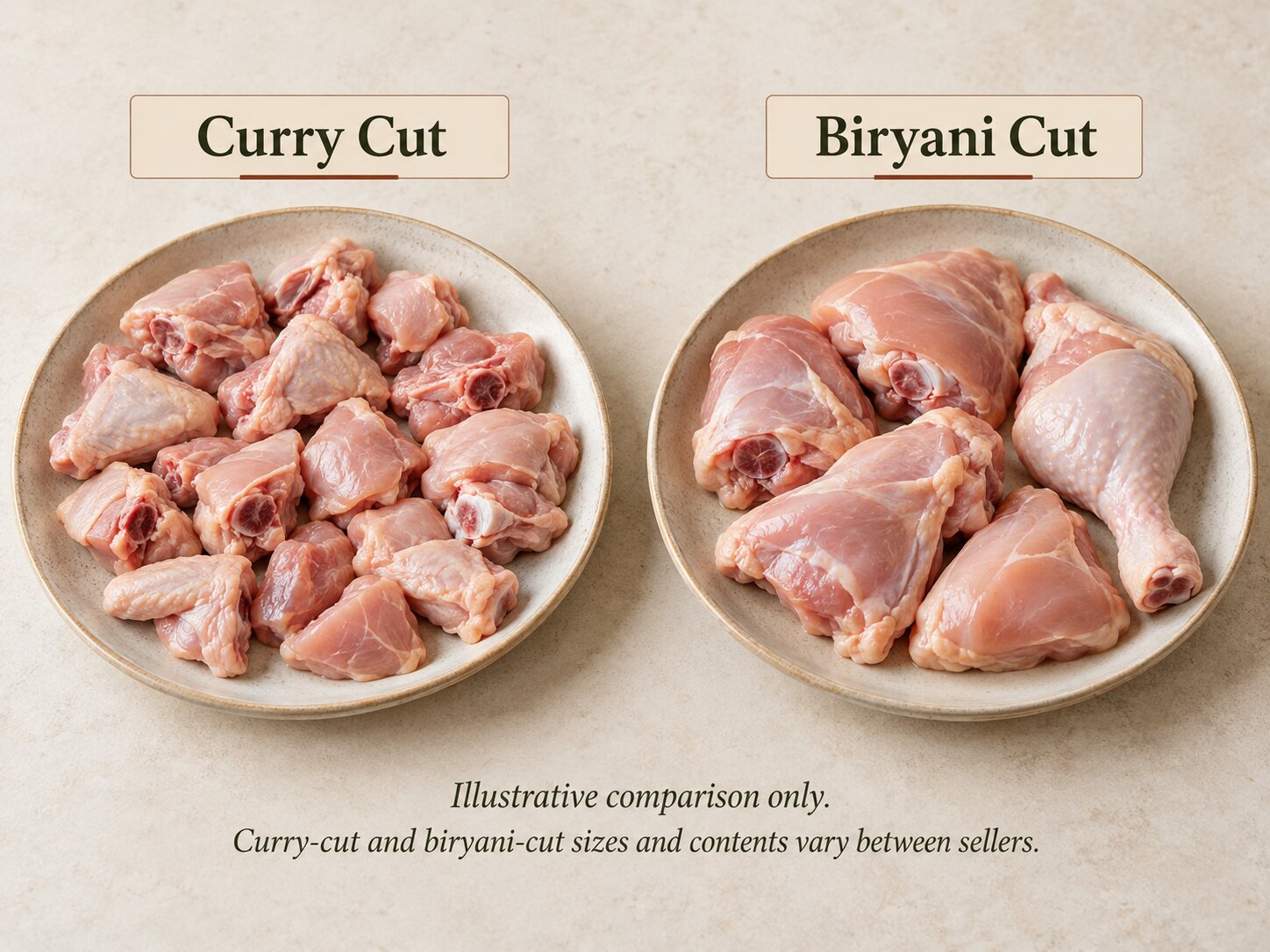
Neither curry cut nor biryani cut identifies one fixed part of a chicken. Both usually describe chicken that a seller has portioned with a particular style of cooking in mind.
What Does Curry Cut Mean?
Curry cut usually means a mix of chicken pieces portioned for curry-style cooking.
Depending on the seller, the pack may contain pieces from the breast, legs, wings, back or other parts of the bird.
The name alone does not tell you exactly which parts are included, how large the pieces are, whether the neck or backbone is included, whether liver or gizzard comes with the pack, or whether the chicken is skin-on or skinless.
For example, Licious currently lists one 500 g curry cut as 12 to 14 skin-on, bone-in pieces from the leg, breast and wings.
FreshToHome, meanwhile, sells several different curry-cut formats alongside separate biryani, whole-leg, thigh and breast products.
Both can be sold as curry cut, but that does not guarantee the same piece size or mix.
What Does Biryani Cut Mean?
Biryani cut is another preparation label.
It often refers to larger pieces than a regular curry cut. FreshToHome currently describes its 480 to 500 g skinless biryani cut as 8 to 10 pieces of 50 g or more and says the pieces are larger than its usual curry cut.
But there is no single piece count or composition that every seller follows.
TenderCuts currently lists its 480 to 500 g biryani cut as 5 to 6 pieces, with separate skin-on and skin-off versions.
The useful takeaway is simple: biryani cut tells you the intended preparation format, while the seller’s actual description tells you what you are buying.
Why the Same Label Can Look Different From One Seller to Another
A quick look at current Indian listings makes the variation easier to see.
These examples were reviewed in September 2026. They show how individual sellers use the terms rather than defining what every curry or biryani cut must contain.
| Seller | Product | Approx. pack size | Piece details |
|---|---|---|---|
| FreshToHome | Skinless curry cut | About 450 g | Medium curry-cut pieces; specifications vary by listing or location |
| FreshToHome | Skinless biryani cut | 480–500 g | 8–10 pieces, 50 g+ |
| Licious | Curry cut with skin | 500 g | 12–14 bone-in pieces from leg, breast and wings |
| TenderCuts | Biryani cut | 480–500 g | 5–6 pieces |
FreshToHome’s current biryani listing also specifies no gizzard, liver or wing tip and includes a partial neck piece, showing that the differences can involve more than piece count alone.
The point is not that one seller has the “correct” definition.
It is that the same broad label can appear on packs with noticeably different piece sizes and contents.
Note
If piece size or composition matters to your dish, check the seller’s description rather than relying on the headline name alone.
Offal Is Different From a Chicken Cut
You may also find liver, gizzard or heart included with a mixed chicken pack.
These are edible offal, not cuts such as breast, thigh or drumstick. FSSAI specifically includes the gizzard, liver and heart in its definition of poultry edible offal.
The distinction matters because inclusion varies.
One curry-cut pack may come with liver or gizzard, while another may specifically exclude them. If you do not want offal in the dish, check the pack details or ask the butcher rather than assuming either way.
How to Read a Chicken Product Label
Once you understand the different parts of a label, long product names become much less confusing.
Take:
Chicken Curry Cut, Skinless, Bone-In, Large Pieces
Curry cut tells you how the chicken has been portioned.
Skinless means the skin has been removed.
Bone-in means the bones remain.
Large pieces tells you about the portion size.
What the name may still not tell you is the exact mix of breast, thigh, wings, back or other pieces. That is when the detailed product description becomes useful.
Now compare that with:
Boneless Chicken Breast Cubes
This one is much more specific. You know the meat comes from the breast, the bones have been removed, and the meat has been cut into cubes.
A label such as Boneless Chicken Cubes leaves one detail open: it does not necessarily tell you which part of the chicken supplied the meat.
FreshToHome’s current poultry catalogue, for example, lists boneless breast, boneless thigh and boneless chicken cubes as separate products.
The same principle applies to skin. Skin-on means the skin is still attached; skinless means it has been removed. Either description can be combined with an anatomical cut or a prepared format.
What About Chicken Mince?
Chicken mince, or chicken keema, is ground chicken rather than an anatomical cut.
What matters is what meat has gone into the mince. Some products specify the source more clearly than others, so check the description when its composition matters to your cooking.
Five Details Worth Checking
When a chicken listing is unclear, these five questions usually tell you what you need to know:
- Which part or mix of parts am I getting?
- How large are the pieces?
- Is it bone-in or boneless?
- Is the skin on or off?
- Are neck, backbone or offal included?
You may not need every answer for every dish. But when a recipe depends on a particular cut or piece size, these details are more useful than the product name by itself.
Which Cuts Work for Different Kinds of Cooking?
There is no single correct chicken cut for every Indian dish. Recipes, household preferences and regional cooking styles all differ.
For a bone-in chicken curry, mixed curry cut, thighs or drumsticks are common options.
For biryani, larger pieces are often useful when you want the chicken to stay substantial through the cooking process, whether those pieces come in a seller’s biryani pack or are chosen separately.
For boneless dishes, both breast and thigh can work. Which one makes more sense depends on the recipe and how it is cooked.
For wing-based snacks or grilling, whole wings, wing sections or prepared lollipops are natural options.
Think of these as starting points, not rules. The name on the pack matters less than whether the pieces suit the way you plan to cook them.
How to Ask for the Chicken You Want
You do not need perfect butcher terminology. Being specific about a few practical details is usually enough.
Instead of simply asking for:
“One kilo curry cut.”
you could say:
“One kilo skinless curry cut, bone-in, medium pieces, without liver or neck.”
For boneless dark meat:
“500 grams boneless thigh, cut into medium pieces.”
If you know which part you want, roughly how large the pieces should be, whether you want bone or skin, and anything you want included or left out, you are much less likely to end up with a pack that does not suit the dish you planned to cook.